Dogs who shop, bury frogs, and take 800-mile solo round trips
by rail – writer and broadcaster Frank Key gives a brief tour of the
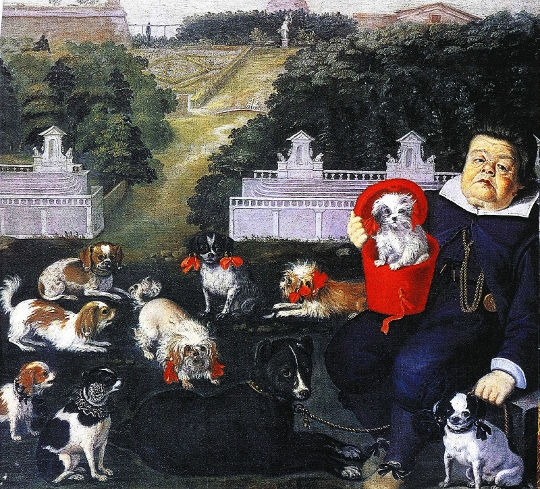
strange and delightful Dog Stories from The Spectator. Dogs Belonging to the Medici Family in the Boboli Gardens by Tiberio Di Tito (1573–1627)
Here is a puzzle:
[Feb. 2, 1895.] I venture to send you the following story I have lately
heard from an eye-witness, and to ask whether you or any of your readers
can throw any light upon the dog’s probable object. The dog in question
was a Scotch terrier. He was one day observed to appear from a corner
of the garden carrying in his mouth, very gently and tenderly, a live
frog. He proceeded to lay the frog down upon a flower-bed, and at once
began to dig a hole in the earth, keeping one eye upon the frog to see
that it did not escape. If it went more than a few feet from him, he
fetched it back, and then continued his work. Having dug the hole a
certain depth, he then laid the frog, still alive, at the bottom of it,
and promptly scratched the loose earth back into the hole, and friend
froggy was buried alive! The dog then went off to the corner of the
garden, and returned with another frog, which he treated in the same
way. This occurred on more than one occasion; in fact, as often as he
could find frogs he occupied himself in burying them alive. Now dogs
generally have some reason for what they do. What can have been a dog’s
reason for burying frogs alive? It does not appear that he ever dug them
up again to provide himself with a meal. If, sir, you or any of your
readers can throw any light on this curious, and for the frogs most
uncomfortable, behaviour of my friend’s Scotch terrier, I should be very
much obliged. – R. Acland-Troyte.
It appears in a curious volume entitled Dog Stories From The
Spectator : Being Anecdotes Of The Intelligence, Reasoning Power,
Affection And Sympathy Of Dogs, Selected From The Correspondence Columns
Of The Spectator by J St Loe Strachey (1895). Strachey’s purpose,
as given in his introduction, is to provide “no little entertainment for
all who love dogs”, and in this he surely succeeds. Indeed, one may
have no liking for dogs whatsoever, yet find many of these stories oddly
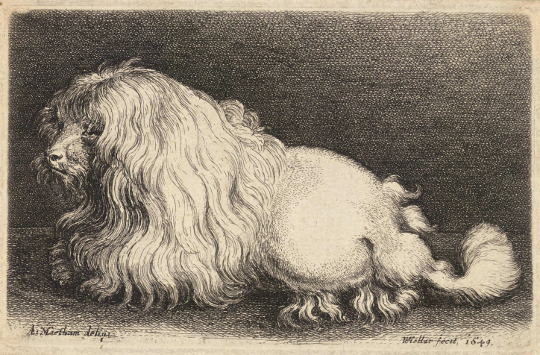
compelling. A Poodle after Matham by Wenceslas Hollar (1607-1677)
There are tales of syllogistic dogs, sermonising dogs, hospital dogs,
parcel-carrying dogs, and purchasing dogs – that is, dogs which
“understand the first principles of the science of exchange”. We learn
of dogs with a sense of humour, dogs’ talent for friendship with hens,
rabbits, and pigeons, dogs that foretell death, and dogs that recognise
themselves in the mirror. By the time we get to the end of the book we
may agree with Strachey that “a single story of a clever dog may amuse,
but… if we have half a dozen illustrating the same form of intelligence,
the value of the evidence is enormously increased”.An added pleasure of the book is, of course, its age. This was a time
when the correspondence columns of a general interest magazine were
filled with letters written in formal, elegant, crafted prose. The sense
of a lost world of good manners and civility could not be better
expressed than in Strachey’s apology, worth quoting in full: